Acropolis of Rhodes

The Acropolis of Rhodes is the acropolis of the ancient city, on Monte Smith, west of Rhodes Old Town: temples, a stadium and an odeion on terraces, built in the 3rd and 2nd centuries BC. Entry is free and the site never closes. Hippocrates Square is 2.2 km away on foot, uphill. It is not the Acropolis of Lindos.

Updated

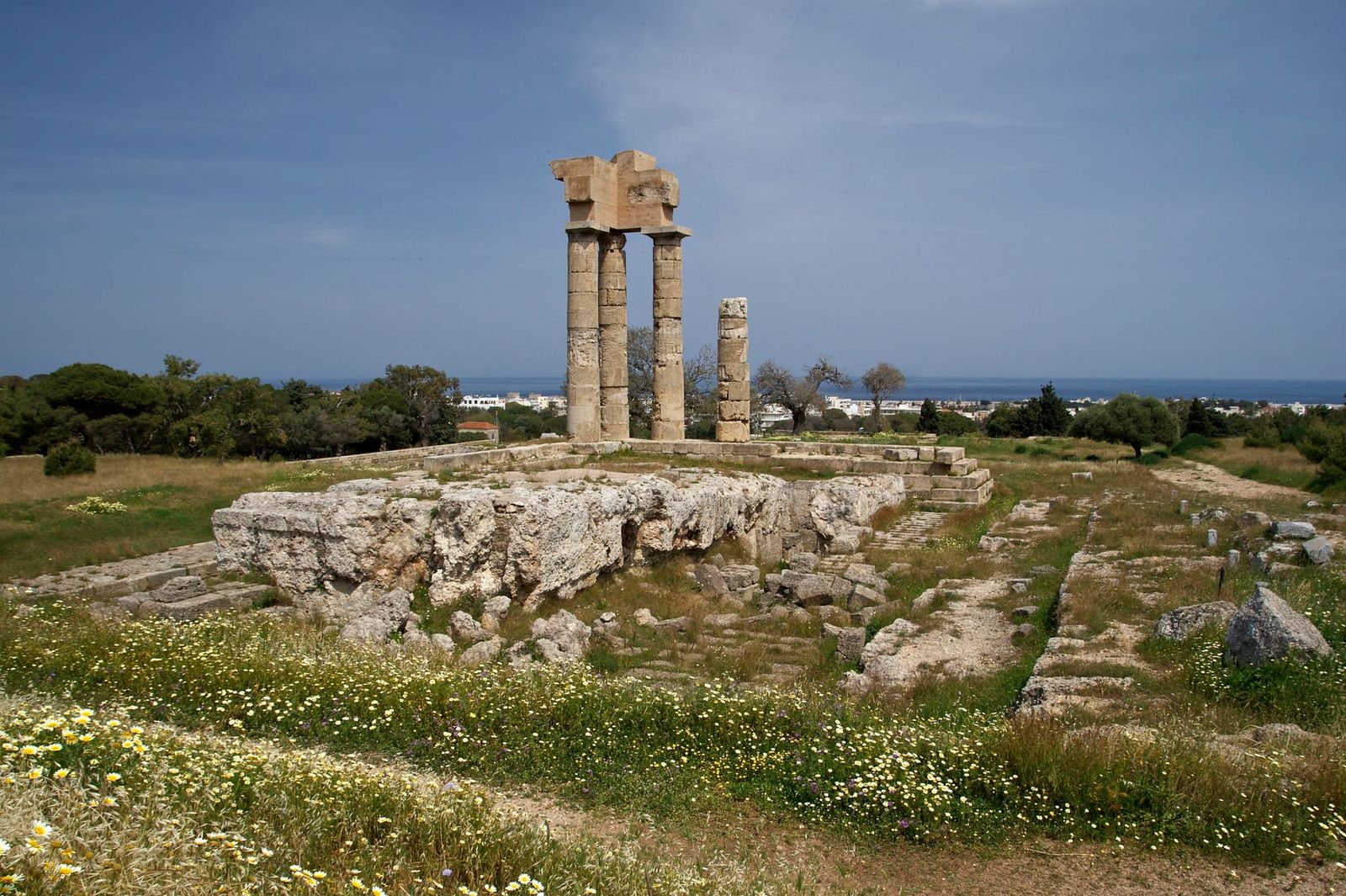
The re-erected columns of the Temple of Apollo on Monte Smith, above a terrace with spring flowers

Key facts

Entry
FreeThe stadium included
Opening hours
Always openAn open-air site
On foot from Hippocrates Square
2.2 kmUphill: the way climbs Monte Smith
Built
3rd to 2nd century BCHellenistic
Stadium
210 m longOne ancient stadion
Odeion
About 800 seatsMostly rebuilt by the Italians
Temple of Apollo
Under restorationWork in progress in October 2025

What the Acropolis of Rhodes is, and where

The Acropolis of Rhodes was the western and highest part of the ancient city. Unlike most Greek acropoleis it was never fortified. It was a zone of sanctuaries, large temples, public buildings and underground places of worship, built on stepped terraces that strong retaining walls held up. The buildings are Hellenistic, of the 3rd and 2nd centuries BC.

The hill is called Monte Smith, after the British admiral William Sidney Smith; its Greek name is Agios Stefanos, St Stephen’s Hill. It lies west of Rhodes Old Town and overlooks the west coast of the island.

It is not the Acropolis of Lindos. That one stands above the village of Lindos, on the south-east coast of the island, and has paid entry and fixed hours. The Acropolis of Lindos is a day trip from the town; the Acropolis of Rhodes is a walk from the old town.

Entry and opening hours

Sunset from Monte Smith

Monte Smith overlooks the west coast of the island, and the acropolis is one of the places in Rhodes Town for watching the sunset. As the site never closes, only the month decides the hour: in the middle of June the sun sets at about 20:27, in the middle of December at about 16:53.

Sunset time at the Acropolis of Rhodes, month by month
  • Sunset
  • Dusk until dark
  1. JanSunset 17:15, Dusk until dark 17:43
  2. FebSunset 17:48, Dusk until dark 18:14
  3. MarSunset 18:14, Dusk until dark 18:40
  4. AprSunset 19:41, Dusk until dark 20:07
  5. MaySunset 20:07, Dusk until dark 20:36
  6. JunSunset 20:27, Dusk until dark 20:57
  7. JulSunset 20:25, Dusk until dark 20:55
  8. AugSunset 19:58, Dusk until dark 20:25
  9. SepSunset 19:15, Dusk until dark 19:41
  10. OctSunset 18:31, Dusk until dark 18:57
  11. NovSunset 16:59, Dusk until dark 17:26
  12. DecSunset 16:53, Dusk until dark 17:22

Rhodes time in the middle of each month, calculated for the position of the Acropolis.

Getting there from the old town

The Acropolis is 2.2 km on foot from Hippocrates Square, and the way climbs Monte Smith. A taxi or a car goes up to the site.

  • On foot

    From Hippocrates Square the way runs along Sokratous Street and Orfeos Street, then out through the d’Amboise Gate and up Diagoridon Street to the site. It is 2.2 km to the middle of the site, 2.3 km to the stadium and 2.5 km to the Temple of Apollo. The way climbs the hill, so it takes longer than the same distance on flat ground.

    • 2.2 km
    • Uphill
  • By taxi or car

    The site can be reached by taxi and by car. The taxi ranks by the gates of the old town are outside the Marine Gate and the Liberty Gate.

What to see: the stadium, the odeion and the Temple of Apollo

The monuments stand apart on the terraces of the hill, in a grove of myrtle, laurel, oak, pine and cypress with footpaths between them.

The monuments of the Acropolis of Rhodes on Monte Smith
  1. Ancient stadiumOn the south-east side of the hill
  2. OdeionNorth-west of the stadium
  3. Temple of Pythian ApolloOn the southern part of the hill
  4. Acropolis of RhodesThe middle of the archaeological site
  5. Monte SmithThe hill, also called St Stephen’s Hill

2nd century BC

Ancient stadium

The stadium lies on the south-east side of the hill, below the Temple of Apollo, and runs from north to south. It was built in the 2nd century BC and is one stadion long: 600 feet, or 210 m. The Italians excavated it and restored it throughout. The original parts are the rounded end with its turning post, the seats of the officials, some of the lower rows and the starting mechanism for the athletes. Some visitors come here to jog or to exercise.

Small marble theatre

Odeion

North-west of the stadium is a small marble odeion for about 800 spectators. It is thought to have been used for music, or for the lessons of the Rhodian orators. It is largely rebuilt: only the orchestra and a few seats of the front row are original, and the rest is the Italian restoration. Performances of ancient drama and other events are held in it today.

Under restoration

Temple of Pythian Apollo

The Doric temple of Apollo stood on the southern part of the hill, on the west side of a large terrace. The four columns and the piece of architrave on its north-east side were set up again by the Italians under Mario Paolini, in 1937–1938.

The temple is being restored. The work was in progress in October 2025: the monument is taken apart, and the faults of the earlier restorations are corrected. The columns may not be standing when you visit.

The highest point

Temple of Athena Polias and Zeus Polieus

On the northern edge of the acropolis stood a Doric temple with columns on all four sides. Four oversize column drums and parts of a capital and of the architrave are left. The Rhodians kept the texts of their treaties with other states here. This is the highest part of the site, with a panoramic view of Rhodes.

Rock-cut chambers

Nymphaia

Near the temple of Athena and Zeus, chambers cut into the rock lie below ground, with entrance steps, connecting passages and a large opening in the roof. Niches in their walls held statuettes, and there are water cisterns. They were places of recreation and worship.

Less is left of the other buildings. The gymnasium, east of the stadium, was a square building of some 200 m a side, and only parts of it have been uncovered. On the terrace of the Temple of Apollo are the ruins of other places of worship, one of them attributed to Artemis. Of a stoa whose front was seen from the lower town and the harbour, the foundation wall survives.

The acropolis in brief

The ancient city of Rhodes was founded in 408 BC, and the acropolis was its highest part. In the 2nd century AD the orator Aelius Aristides described it as “full of fields and groves”.

Italian archaeologists began to dig on the hill in 1924 and uncovered the Temple of Apollo, the odeion and the stadium. The Greek Archaeological Service has excavated here since 1946. In the Second World War machine-gun posts were set up at the temple, and the damage was repaired in 1959–1960.

Some researchers place the Colossus of Rhodes on this hill, at the top of the acropolis, and not at the harbour.

Frequently asked questions

Is the Acropolis of Rhodes free?

Yes. Entry to the Acropolis of Rhodes on Monte Smith is free, and that includes the ancient stadium, the odeion and the Temple of Apollo. There are no opening hours either: it is an open-air archaeological site, and it is always open.

How old is the Acropolis of Rhodes?

Its buildings date from the 3rd and 2nd centuries BC, the Hellenistic period; the stadium is of the 2nd century BC. The city they belonged to was founded in 408 BC. Much of what stands today, such as the columns of the Temple of Apollo and most of the odeion, was put up again by Italian archaeologists.

Can you walk to the Acropolis from the old town?

Yes. From Hippocrates Square it is 2.2 km to the middle of the site, along Sokratous Street and Orfeos Street and then up Diagoridon Street. The way climbs Monte Smith, so it takes longer than the distance suggests. The site can also be reached by taxi or by car.

Is the Acropolis of Rhodes the same as the one in Lindos?

No. The Acropolis of Rhodes is in Rhodes Town, on Monte Smith hill, and entry is free. The Acropolis of Lindos stands above the village of Lindos on the south-east coast of the island, with the temple of Athena Lindia, and it charges entry.

Why is the hill called Monte Smith?

After the British admiral William Sidney Smith. In 1802 the British built an observation post on the hill to watch the movements of Napoleon’s fleet, and the hill took the name of their commander. Its Greek name is Agios Stefanos, St Stephen’s Hill.