Released in 1961
The Guns of Navarone
The film was shot on Rhodes from April to July 1960. Its scenes are set against the medieval old town and Lindos.
Rhodes Old Town is the walled core of a city founded in 408 BC. The Knights of St John, who held it from 1309 to 1522, built its high town and its walls. The Ottomans added mosques and baths, the Italians rebuilt the palace and built the new town, and Greece took over in 1947.
Updated
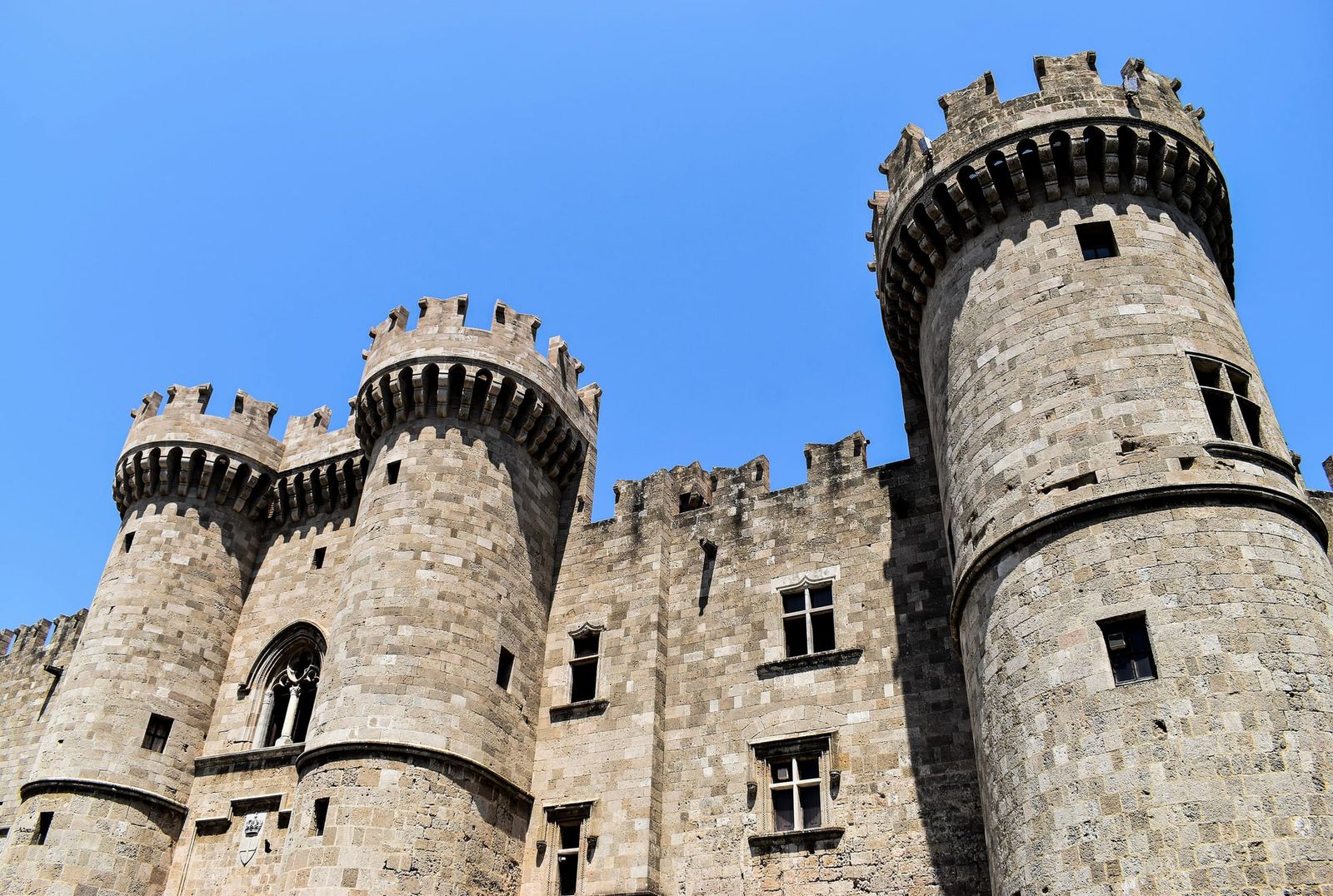
The city of Rhodes was founded in 408 BC at the northern tip of the island, when three older cities merged into one. It was laid out on a regular grid, on the principles of Hippodamus of Miletus, the architect who planned the Piraeus.
Demetrius Poliorcetes besieged the city in 305 BC and gave up a year later, in 304 BC, leaving his siege engines behind. The statue known as the Colossus of Rhodes was put up to mark the end of that siege.
Inside the walls, the remains of a temple of Aphrodite from the 3rd century BC lie by Symi Square; Italian archaeologists uncovered them in 1922. The ancient acropolis stood outside today’s walls, on the hill of Monte Smith west of the old town.
In Byzantine times the city became much smaller, and from the 7th century walls protected it. Those early walls enclosed the area that the Knights later made their high town, the Collachium. In the early 12th century a new wall enclosed a rectangle of 17.5 hectares.
Arab forces occupied Rhodes in 654, the Genoese held it from 1248 to 1250, and in 1305 the island was given as a fief to the Genoese Andrea Morisco.
The Byzantine citadel stood where the Palace of the Grand Master stands now: the Knights built their palace on it. Our Lady of the Castle, the church on Museum Square, was most likely built in the 11th century as a Byzantine church.
The Knights of St John, also called the Knights Hospitaller, lost their base in the Holy Land when Acre fell in 1291, and moved their seat and their hospital to Limassol on Cyprus. They landed on Rhodes in 1307 under Grand Master Foulques de Villaret and took the town in 1309. By 1310 the island was theirs and the Order had moved its seat here.
Until 1522 the town was the headquarters of a state of their own, which also took in most of the other Dodecanese islands. The Grand Master governed it with a Council, and the Order minted its own coins and kept diplomatic relations with other states.
The Knights were grouped into tongues (langues) by the language they spoke. There were seven at first, Provence, Auvergne, France, Italy, Aragon, England and Germany, and later eight, with Castile and Portugal. The inns of the tongues stand along the Street of the Knights.
The high town is their work: the Palace of the Grand Master, the Great Hospital, which is now the Archaeological Museum, and the Street of the Knights. They turned the Byzantine citadel into the Grand Master’s residence from the early 14th century. With Italian engineers they strengthened the fortifications against gunpowder. Their walls, built in the mid-14th century on an earlier line, were remade after the siege of 1480 and the earthquake of 1481. The walls and gates still ring the old town.
The walls held against the Sultan of Egypt and against Mehmed II. The siege of 1522, led by Suleiman the Magnificent, ended the rule of the Knights.
1444
The fortified town withstands the attack.
23 May 1480
An Ottoman army under Mesih Pasha lands on the island. Grand Master Pierre d’Aubusson leads the defence. The first target is the Fort of St Nicholas, which guards the harbours.
27 July 1480
At dawn the Janissaries take the tower of Italy, on the wall by the Jewish quarter that faces the bay of Akantia, and enter the town. The defenders drive them out again.
17 August 1480
Mehmed II dies in 1481, before a second attempt.
26 June 1522
Suleiman the Magnificent arrives on 28 July to take charge of his army himself.
4 September 1522
Two gunpowder mines explode under the bastion of England and bring down a section of the wall.
17 December 1522
The Ottomans take the bastion of Spain.
22 December 1522
After six months of siege the Knights surrender. They are given twelve days to leave the island and may take their weapons, their valuables and their religious icons.
1 January 1523
The remaining Knights and soldiers march out of the town with banners flying and sail for Crete.
1530
After Crete and Sicily the Order settles on Malta, which Emperor Charles V grants to Grand Master Philippe de Villiers de l’Isle-Adam.
Rhodes stayed Ottoman from 1522 until 1912. The new rulers took over the walled town, and Christians were no longer allowed to live in it. The gates were closed at night, and Greeks who kept shops inside had to leave each evening. They built small houses close together in the fields outside, in neighbourhoods called marasia: the beginning of the town that grew outside the walls. The Jewish community stayed inside.
Most churches became mosques, and the large houses became mansions or public buildings. Our Lady of the Castle, which the Knights had rebuilt as a Gothic basilica, was one of the churches turned into a mosque. The Ottomans also built new mosques, public baths and mansions. In the lower town they stand among the Gothic houses.
The Suleiman Mosque at the top of Sokratous Street was the first mosque built after the conquest and was rebuilt in 1808. The Turkish bath dates from 1558 and the Hafiz Ahmed Aga Library from 1793. The Ibrahim Pasha Mosque is the only mosque on the island still used for prayer. The library stands next to the mosque, on the hill of the old town.
The Palace of the Grand Master was used as a prison. In 1856 lightning struck a gunpowder magazine under the Church of St John next to it, and the explosion destroyed the church and much of the palace.
Italy occupied the Dodecanese in May 1912, during the Italo-Turkish War; its troops landed on Rhodes on 4 May. Turkey ceded the islands to Italy in the Treaty of Lausanne of 1923.
The town plan of 1923, drawn up by the architect Florestano Di Fausto under Governor Mario Lago, left the walled town almost untouched. Only the houses built on and around the walls in Ottoman times were pulled down, and the Jewish and Ottoman cemeteries outside became a belt of green around the medieval town. The new town went up beyond it, with the public buildings along the waterfront at Mandraki.
Inside the walls the Italians rebuilt the Palace of the Grand Master between 1937 and 1940. The architect Vittorio Mesturino designed the work there and on the Street of the Knights, and it has been criticised for its lack of historical accuracy.
Italian rule grew harsher from 1936, when the Italian language was imposed, and the racial laws followed in 1938. After the Italian armistice of 8 September 1943 German forces occupied the island. On 23 July 1944 they deported the Jews of Rhodes, about 1,650 to 1,700 people, of whom about 150 survived; the memorial to them stands on the Square of the Jewish Martyrs. The surrender of the islands to the Allies was signed on Symi on 8 May 1945, and a British administration followed.
10 February 1947
The peace treaty with Italy is signed in Paris. It gives the Dodecanese to Greece.
31 March 1947
The British hand the administration over to Greece, with a ceremony on every island. Until the treaty is ratified, Greece holds military command and not yet sovereignty.
22 October 1947
Greece ratifies the treaty.
7 March 1948
The union of the Dodecanese with Greece is celebrated.
UNESCO put the old town on the World Heritage List in 1988 as the Medieval City of Rhodes. The listing takes in the Italian years as well: UNESCO counts the buildings reconstructed after 1912 as a permanent part of the town’s history. The listed town is still lived in: about 2,000 people had their homes inside the walls at the 2011 census, among the monuments a visitor comes to see.
Released in 1961
The film was shot on Rhodes from April to July 1960. Its scenes are set against the medieval old town and Lindos.
Released in 1964
A Spanish-Italian feature film directed by Luis Lucia. Its locations in the old town were the Palace of the Grand Master, the Naillac Tower, the moat and the church of Panagia tou Bourgou.
The Guns of Navarone, shot on Rhodes from April to July 1960 and released in 1961, has scenes set in the old town and in Lindos. The Spanish-Italian film Crucero de verano, released in 1964, used the Palace of the Grand Master, the Naillac Tower, the moat and the church of Panagia tou Bourgou.
Rhodes was Ottoman until Italy occupied the Dodecanese in May 1912, and Turkey ceded the islands to Italy in the Treaty of Lausanne of 1923. After the Second World War the peace treaty with Italy, signed in Paris on 10 February 1947, gave them to Greece. The union was celebrated on 7 March 1948.
Yes. Italy occupied Rhodes in May 1912, during the Italo-Turkish War, and Turkey ceded the Dodecanese to Italy in the Treaty of Lausanne of 1923. Italian rule ended after the armistice of 8 September 1943, when German forces occupied the island. The rebuilt Palace of the Grand Master and the new town date from the Italian years.
The Knights of St John, or Knights Hospitaller: an order that moved to Cyprus after Acre fell in 1291 and took the town of Rhodes in 1309. Until 1522 they ruled the island and most of the Dodecanese as a state of their own, under a Grand Master, grouped into tongues by the language they spoke.
The city was founded in 408 BC. The walled town is younger: its first walls date from the 7th century, in Byzantine times, and the Palace of the Grand Master, the hospital and the Street of the Knights were built after the Knights of St John took the town in 1309.