The Italian governor’s seat
Government House
Built from 1924 to 1936 as the seat of the Italian governor of the Dodecanese, north of Eleftherias Square. Its design recalls the Doge’s Palace in Venice.
Mandraki Harbour, with the municipal marina of Rhodes Town, lies just north of Rhodes Old Town through the Liberty Gate. A bronze stag and doe stand on columns at its mouth. Its pier carries three 15th-century windmills and the Fort of St Nicholas, built from 1464 to 1467. The windmills are 10 min on foot from Hippocrates Square.
Updated
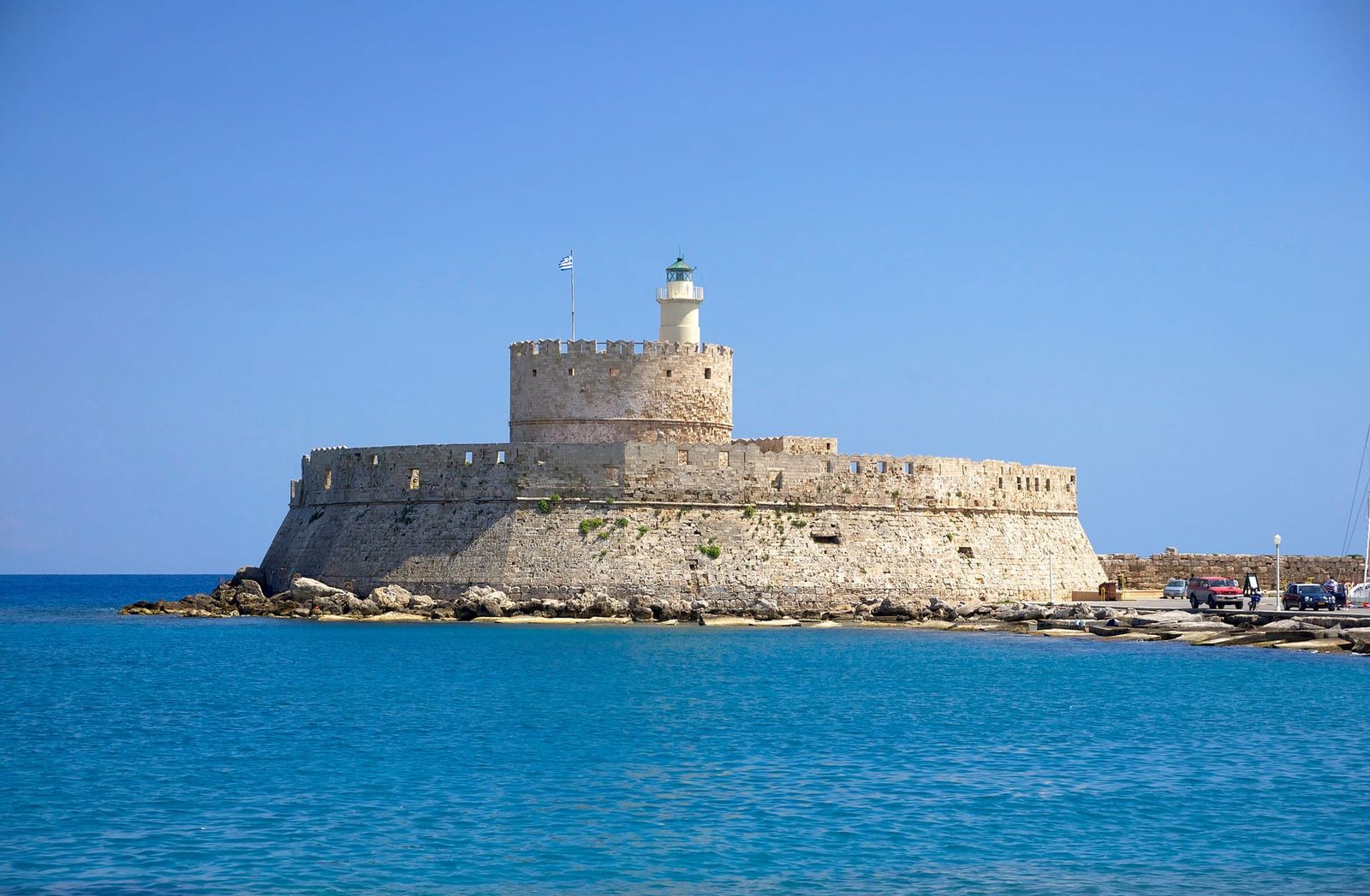
Mandraki is one of the three ports of Rhodes Town, just north of the walls of the old town; the ferries use the commercial harbour. Mandraki was the war harbour of the ancient city and later of the Knights of St John. Its Hellenistic pier runs about 500 m north, with the windmills along it and the fort at its tip. The basin is sheltered from every wind but the east wind.
From the old town you walk out through the Liberty Gate, which the Italians opened in 1924. The route from Hippocrates Square follows Ermou Street to the gate and then the waterfront.
10 min on foot
Along the eastern side of the pier.
13 min on foot
At the tip of the pier, seen from outside.
13 min on foot
On the waterfront, on Eleftherias Square.
14 min on foot
On the western column at the harbour mouth.
15 min on foot
On the eastern column, across the harbour mouth.
Two tall columns of tufa stand at the mouth of the harbour, one on each side, each with a bronze deer on top: the stag on the western column, the doe on the eastern one. The deer are symbols of the island. In Greek they are simply the elafos, the stag, and the elafina, the doe.
Local tradition puts the Colossus where the deer now stand, with ships sailing between its feet. The statue could not have stood astride the harbour, and where the Colossus may really have stood is still debated.
Three windmills stand in a row on the eastern side of the pier. They were built after 1420 and before 1483, and by 1496 the pier had at least three. They ground the grain that merchant ships brought into the harbour. The pier is a public walk, and the mills are seen from it.
They are not the windmills of the pier of the Mills, which closes the commercial harbour, where the ferries dock. By the end of the 15th century more than 13 windmills worked on that pier; one is left.
The fort, Agios Nikolaos in Greek, stands on the northern tip of the pier. Grand Master Zacosta of the Knights of St John built it from 1464 to 1467 as a round tower, probably on the site of a church of St Nicholas recorded there in 1394. A relief of the saint is set high on the east side of the tower.
The fort was a key to the defence of the town, and in the siege of 1480 it was the Ottomans’ first target. After the siege Grand Master Pierre d’Aubusson surrounded the tower with a ditch and a bastion and made it a fort on the sea. Medieval tradition placed the Colossus on the rock at the end of this pier.
The large buildings along the Mandraki waterfront date from the Italian period, which began in 1912. They went up under the governor Mario Lago, with Florestano Di Fausto as head architect, in a style that mixes Ottoman, Venetian, Renaissance and local forms.
The Italian governor’s seat
Built from 1924 to 1936 as the seat of the Italian governor of the Dodecanese, north of Eleftherias Square. Its design recalls the Doge’s Palace in Venice.
The cathedral of Rhodes
13 min on foot 970 m
Built from 1924 to 1925 as the Catholic church of St John, a copy of the Knights’ church of St John that stood opposite the Palace of the Grand Master until an explosion destroyed it in 1856. The outside has not changed. The inside was adapted to Orthodox worship in 1947, and Fotis Kontoglou and his assistants painted it from 1951 to 1961.
The fountain in the churchyard is a copy of one in Viterbo.
Across the street from the church
The City Hall and the National Theatre stand on the other side of the street from the Church of the Annunciation.
Along the harbour
The square runs along the harbour by the sea. Around it stand the Bank of Greece, the Aktaeon café, the Courthouse, the Port Authority and the Post Office.
At the southern end of the waterfront stands the New Market (Nea Agora), the market hall outside which the buses start; it belongs to the new town beyond the walls.
Mandraki is shallow, so only yachts and small boats use it. Small boats make trips from the quay to the beaches of Rhodes and to the neighbouring islands, and excursion boats leave every day for Symi and down the east coast to Lindos. A day trip by boat to Symi can start here; the ferries and the cruise pier are at the other harbours.
Rhodes Town has two marinas: the municipal marina at Mandraki, with 175 berths for yachts up to 30 m long, and a private one next to the port of Akantia.
The main taxi rank of the town is at Mandraki. Behind it is one of the three ways into the moat around the old town, free at any hour.
Yes. The pier is a public walk, and it leads past the three windmills to the Fort of St Nicholas at its tip. From Hippocrates Square the windmills are 10 min on foot, 710 m, out through the Liberty Gate; the fort is 13 min on foot. Both are seen from outside.
Not yet. The fort, built from 1464 to 1467, is being restored so that it can be visited safely, under a state project to open it to visitors. Until then it is seen from the pier, 13 min on foot from Hippocrates Square.
The bronze stag and doe are symbols of the island of Rhodes. They stand on two tall columns of tufa at the mouth of the harbour, one on each side. Local tradition puts the Colossus on the same spot, but the statue did not stand astride the harbour.
It is one of two. The municipal marina is at Mandraki, with 175 berths for yachts up to 30 m, and the harbour is sheltered from every wind except the east wind. The other marina is private, next to the port of Akantia. The ferries use the commercial harbour.
They date from the 15th century: they were built after 1420 and before 1483. By 1496 the pier had at least three windmills, and they still stand.