On Museum Square
Inn of England
3 min on foot 190 m
The Inn of England is not on the street itself. It stands on Museum Square, where the street begins.
Odos Ippoton
The Street of the Knights, Odos Ippoton in Greek, is the main street of the Knights’ quarter in Rhodes Old Town. It climbs from Museum Square, where the Knights’ hospital now houses the Archaeological Museum, to Kleovoulou Square below the Palace of the Grand Master. The inns of Italy, France, Spain and Provence stand along it.
Updated
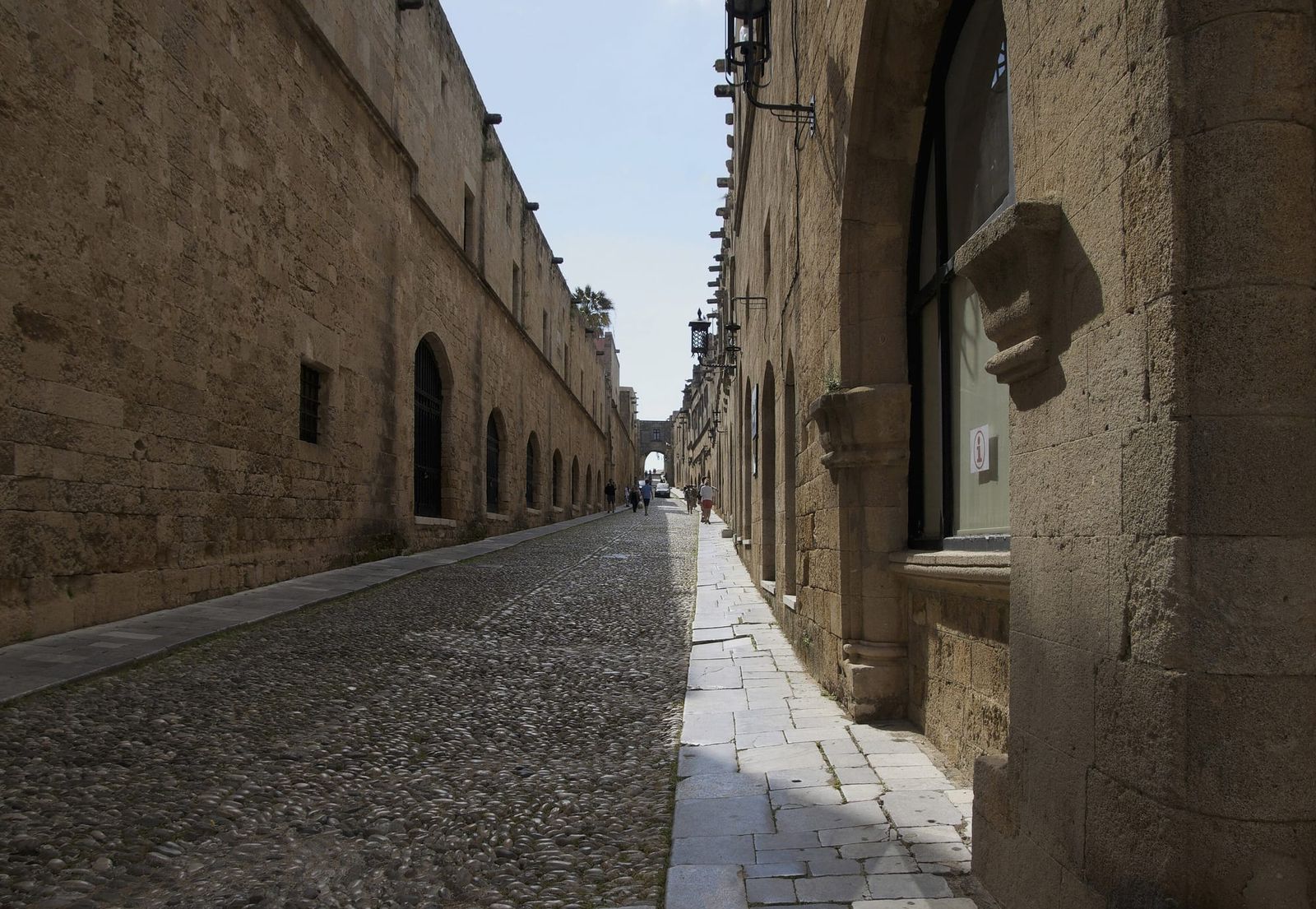
The Street of the Knights is the main street of the Collachium, the high town in the north of the old town. The Knights of St John built this quarter, and a wall once separated it from the rest of the town. The street crosses it from east to west and climbs as it goes. Its Greek name is Odos Ippoton (Οδός Ιπποτών), shortened to Ippoton on maps and in addresses.
The lower end is at Museum Square. The Knights’ hospital at the foot of the street, built between 1440 and 1489, stands on the south side there and is now the Archaeological Museum. The upper end is Kleovoulou Square, below the palace at the top of the street. From Hippocrates Square the lower end is 220 m away, 3 min on foot, and the upper end 540 m, 8 min on foot.
What a walker sees today is a restored street. The Italians restored it and paved it with pebbles, and they rebuilt the palace at its top as a residence for King Victor Emmanuel III and Mussolini.
The Order grouped its knights by language into seven tongues, and each tongue had a seat of its own, its inn. An inn was something between a club and a hotel. The members of a tongue gathered there, though it was not where they lived, and guests of honour were put up in it.
The seven tongues were Provence, Auvergne, France, Italy, Aragon, England and Germany. In 1461 Aragon was divided, and Castile became the eighth. The Knights of St John on Rhodes ruled the island from 1309 to 1522.
Four inns stand on the street: Italy, France and Provence on the right going up, Spain on the left. The inns of England and Auvergne stand on the squares at its foot.
On Museum Square
3 min on foot 190 m
The Inn of England is not on the street itself. It stands on Museum Square, where the street begins.
On Argyrokastrou Square
4 min on foot 270 m
The Inn of Auvergne stands a little north of the foot of the street, on Argyrokastrou Square, close to the site of the Knights’ first hospice. Its facade bears the arms of Guy de Blanchefort, Grand Master from 1512 to 1513.
On the right going up
4 min on foot 270 m
The first inn on the street itself. On its facade are the arms of Grand Master Fabrizio del Carretto (1513 to 1521), dated 1519.
On the right going up
5 min on foot 330 m
The wall of the Inn of France carries dated reliefs. The arms of Emery d’Amboise, later Grand Master (1503 to 1512), stand beside the cross of the Order and are dated 1492. The arms of Grand Master Pierre d’Aubusson (1476 to 1503) are dated 1495. The arms of the Kingdom of France, with three fleurs-de-lis, are dated 1495 as well and may honour King Charles VIII.
On the left going up
5 min on foot 370 m
The Inn of Spain is the only inn on the left side going uphill, about halfway along the street.
On the right going up
6 min on foot 410 m
The last inn before the top. Its facade has four coats of arms set in the shape of a cross and dated 1518: the arms of the Kingdom of France at the top, the cross of the Order on the left, the arms of Grand Master Fabrizio del Carretto on the right and, below, those of F. Flotta, Prior of Toulouse.
The inns are seen from the street. No inn of the German tongue survives. The map of the old town shows where the street lies between the gates and the other sights. Past the top of the street, the d’Amboise Gate beyond the palace leads out through the walls.
It starts at Museum Square, beside the Knights’ hospital that is now the Archaeological Museum, and climbs west to Kleovoulou Square, below the Palace of the Grand Master. From Hippocrates Square the lower end is 220 m away, 3 min on foot, and the upper end 540 m, 8 min on foot.
They were the meeting houses of the tongues, the groups by language into which the Order of St John divided its knights. Each of the seven tongues had its own inn, something between a club and a hotel: its members gathered there without living in it, and guests of honour stayed there.
Four: the inns of Italy, France, Spain and Provence. Going uphill, Italy, France and Provence are on the right and Spain is on the left, about halfway. The Inn of England stands on Museum Square at the foot of the street, and the Inn of Auvergne on Argyrokastrou Square, a little to the north.
The coats of arms on the inns of France, Provence and Italy date from the Knights’ time: they are dated between 1492 and 1519. The street as it looks today is a restoration, though. The Italians restored it and paved it with pebbles, and they rebuilt the palace at its top.
Odos Ippoton, written Οδός Ιπποτών. Maps and addresses shorten it to Ippoton: the Palace of the Grand Master at the top of the street gives its address as Ippoton Street.